
Welo Opal
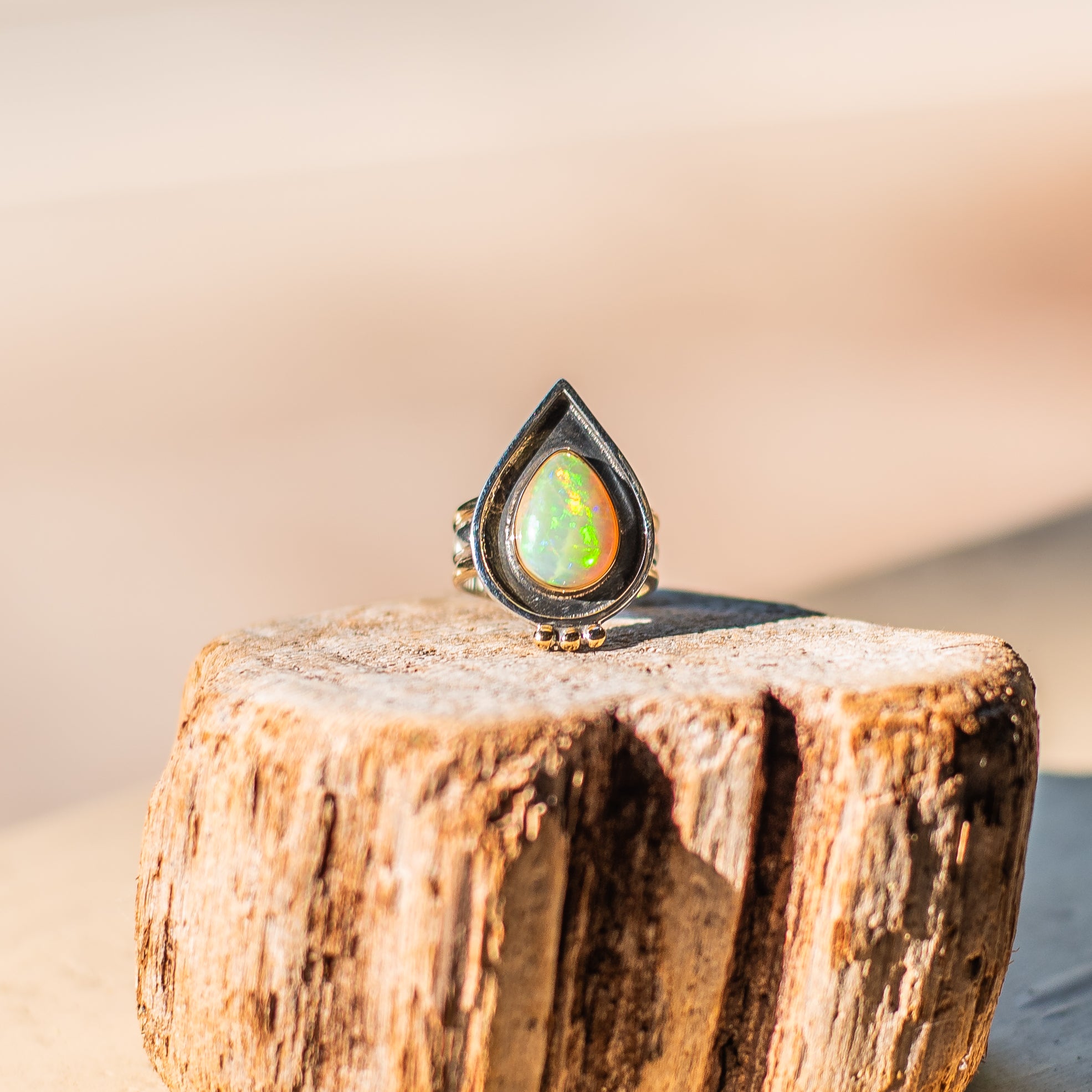
A fiery, water-loving opal discovered in the mountains of Ethiopia less than 20 years ago.
Where It's From
Welo Opal (also spelled Wollo or Wello) comes from Ethiopia's Wollo Province, in the mountainous north of the country. While small amounts of Ethiopian opal were noted in the early 1990s, the deposit that changed everything was discovered in 2008 near the town of Wegel Tena. Before this find, roughly 95% of the world's opal supply came from Australia. Welo Opal introduced an entirely new, high-quality source almost overnight.
How It Forms
Unlike Australian opal, which forms in sedimentary rock, Welo Opal forms in volcanic rock — specifically rhyolitic ignimbrite, a rock made from compacted volcanic ash. Silica-rich water accumulated on top of an impermeable clay layer, and over time that silica precipitated into opal within the rock's pore spaces. This volcanic origin gives Welo Opal a distinctive trait: most of it is hydrophane, meaning it's porous enough to absorb water. When submerged, a piece of Welo Opal can temporarily become more transparent and shift in appearance, then return to normal as it dries, a genuinely unusual property most other opals don't share.
Cultural History
Because it's such a recent discovery, Welo Opal doesn't carry ancient civilization ties the way some stones in this guide do. What it lacks in age, it makes up for in impact, within a few years of the 2008 find, it became one of the most significant developments in the global opal trade, prized for its vivid, neon-like flashes of red, orange, green, and blue.
Spiritual & Traditional Meaning
In crystal healing traditions, opal broadly is associated with creativity, emotional expression, and amplifying feelings. Because Welo Opal is such a recent discovery, it doesn't carry old world folklore the way ancient stones do, its meanings are drawn from more contemporary crystal healing communities rather than historical tradition.
Caring for Welo Opal
Welo Opal's hydrophane nature makes its care different from most stones in this guide:
- Avoid submerging it in water for extended periods — while brief water contact is generally fine, prolonged soaking and repeated wet/dry cycles can lead to cracking over time.
- Avoid extreme temperature changes and prolonged direct sunlight.
- Remove before showering, swimming, or using household chemicals.
- Store away from harder stones that could scratch its relatively soft surface (around 5.5–6.5 on the Mohs scale).
- Clean gently with a soft, dry cloth only.