
Dendritic Opal
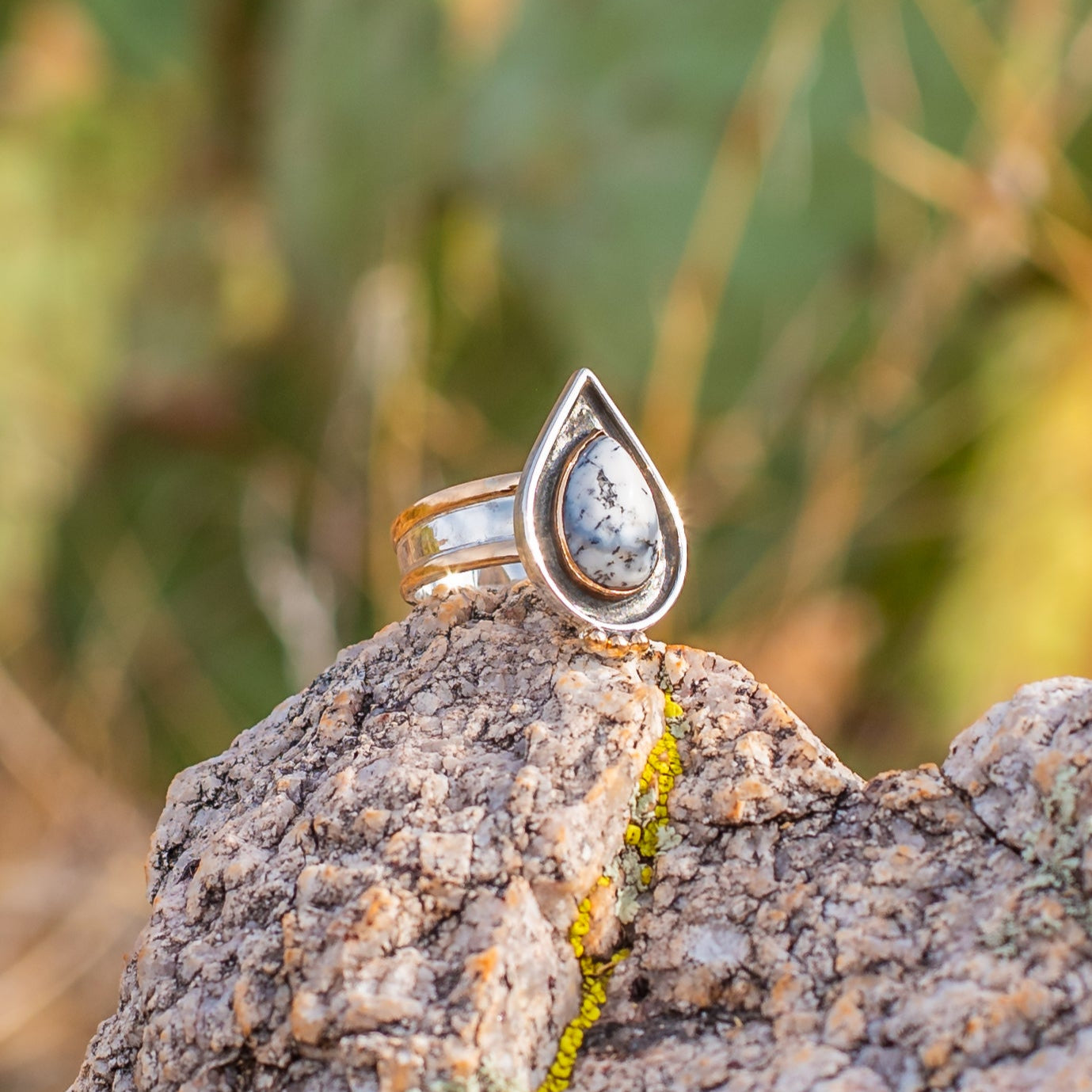
A clear or milky stone with tiny fossil-like "trees" branching through it.
Where It's From
Dendritic opal is found in opal-producing regions worldwide, often alongside other common (non-precious) opal deposits.
How It Forms
Dendritic opal forms when silica-rich groundwater deposits amorphous (non-crystalline) silica into cavities and fractures in host rock, gradually hardening into opal without ever forming a defined crystal lattice. What makes it "dendritic" is the presence of manganese or iron oxide, which seeped into the stone along fracture planes while it was still forming and spread into delicate, branching patterns that look remarkably like trees, ferns, or moss. The word "dendrite" comes from the Greek for "tree," describing exactly that effect. Unlike precious opal, dendritic opal doesn't show play-of-color, its appeal comes entirely from the clarity of the stone and the intricacy of its inclusions.
Cultural History
Dendritic opal has sometimes been called the "Stone of Plenitude" in folk tradition, associated with agriculture and abundance, likely because its branching patterns resemble plant growth, and because opal broadly has a long history of use and symbolism across many cultures.
Spiritual & Traditional Meaning
In crystal healing traditions, dendritic opal is associated with growth, abundance, and connection to nature, a reputation tied directly to its tree-like inclusions.
Caring for Dendritic Opal
As a mineraloid rather than a crystalline stone, dendritic opal is a bit softer and more sensitive than quartz-family stones like agate, so it benefits from a little extra care:
- Avoid prolonged sun exposure and extreme or sudden temperature changes, which can affect the stone over time.
- Remove before showering, swimming, or using household chemicals.
- Store away from harder stones or metals that could scratch it.
- Clean gently with a soft, dry cloth. Skip ultrasonic cleaners.
A note on naming: dendritic opal is often confused with the visually similar dendritic agate. They can look nearly identical to the eye, but they're genuinely different minerals. Dendritic opal is a mineraloid (not a true crystalline mineral), part of the same broader family as precious opal, with a Mohs hardness around 5.5 to 6.5. Dendritic agate, by contrast, is a chalcedony (quartz family) with a hexagonal crystal structure and is notably harder.